Making Corporate Contributions to Biodiversity Conservation Visible: Nature Positive Contribution Certificates Issued to Six Companies
2025.10.9
- Nature Positive initiatives by six companies were evaluated against global targets and municipal goals, and certificates of contribution for FY2024 were issued.
- Of these, four certificates were issued jointly with municipalities, providing more official recognition of the level of contribution.
- Contributions to biodiversity conservation were assessed quantitatively and comprehensively, using the latest scientific knowledge with the cooperation of experts.
The Nature Conservation Society of Japan (NACS-J; Chairperson: TSUCHIYA Toshiyuki) evaluates the contributions of companies working toward achieving Nature Positive through a landscape approach* that takes into account the entire local (municipal) area, and issues Nature Positive Contribution Certificates (Contribution Certificates).
On this occasion, Contribution Certificates were issued to six companies: NTT DOCOMO, Inc.; Goldwin Inc.; JESCO Holdings, Inc.; Nisshin Seifun Group Inc.; Nippon Life Insurance Company; and Mitsubishi Estate Co., Ltd..
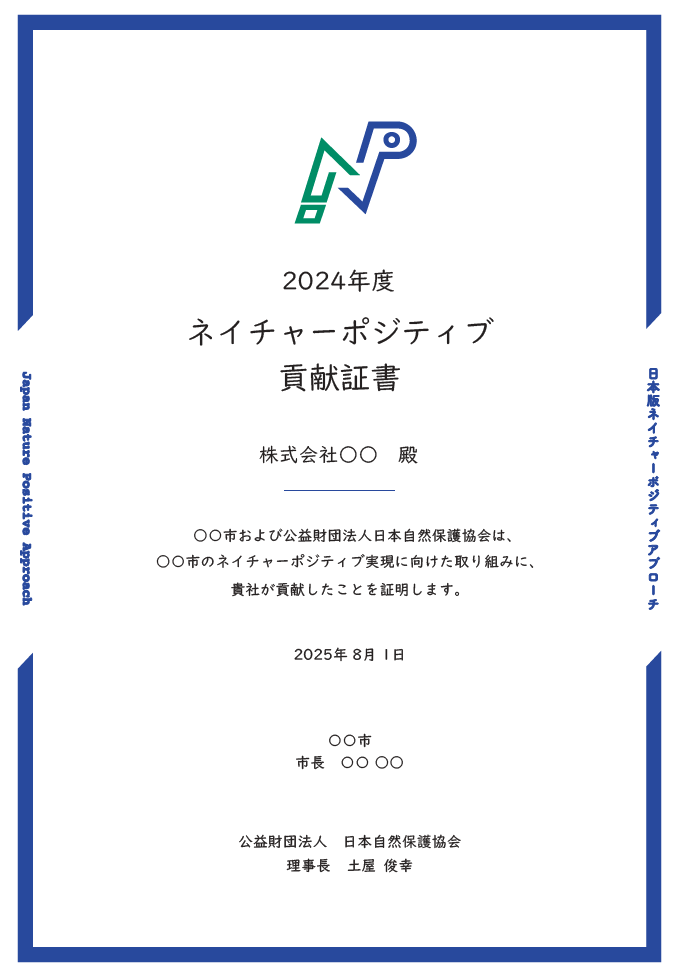
Image of the Contribution Certificate
Contribution Certificates were issued based on an evaluation of each company’s initiatives in FY2024. An overview is provided below.
Table: Companies issued Contribution Certificates for FY2024 and a summary of their contributions
Municipalities marked with an asterisk (*)indicate those that jointly issued the Contribution Certificate with NACS-J.
| Company | Municipality | Summary of Contribution |
|---|---|---|
| NTT DOCOMO Inc. | Tokorozawa City*(Saitama Prefecture) |
|
| Goldwin Inc. | Oyabe City (Toyama Prefecture) |
|
| JESCO Holdings Inc. | Nachikatsuura Town (Wakayama Prefecture) |
|
| Nisshin Seifun Group Inc. | Tadami Town* (Fukushima Prefecture) |
|
| Nippon Life Insurance Company | Koka City* (Shiga Prefecture) |
|
| Mitsubishi Estate Co., Ltd. | Minakami Town* (Gunma Prefecture) |
|
As biodiversity in Japan varies significantly from region to region due to differing natural and social conditions, it is essential that Nature Positive efforts be based on each locality (municipality). Moreover, when promoting initiatives at the watershed and landscape scales, collaboration among diverse stakeholders, including local governments, companies, and citizens, is indispensable.
In recent years in particular, increasing attention has been paid to the roles and responsibilities of companies in achieving Nature Positive. Internationally, there is growing emphasis on the importance of a “landscape approach”, in which companies work in partnership with local communities to advance initiatives at watershed and landscape scales.
These Contribution Certificates quantitatively evaluate the extent to which companies’ Nature Positive efforts to conserve and restore biodiversity contribute to global targets (Kunming-Montreal Global Biodiversity Framework) and to targets set by municipalities. Through this process, companies can objectively visualize the status of their Nature Positive initiatives. The results can also be utilized in corporate nature-related disclosures, such as those aligned with the Taskforce on Nature-related Financial Disclosures (TNFD**).
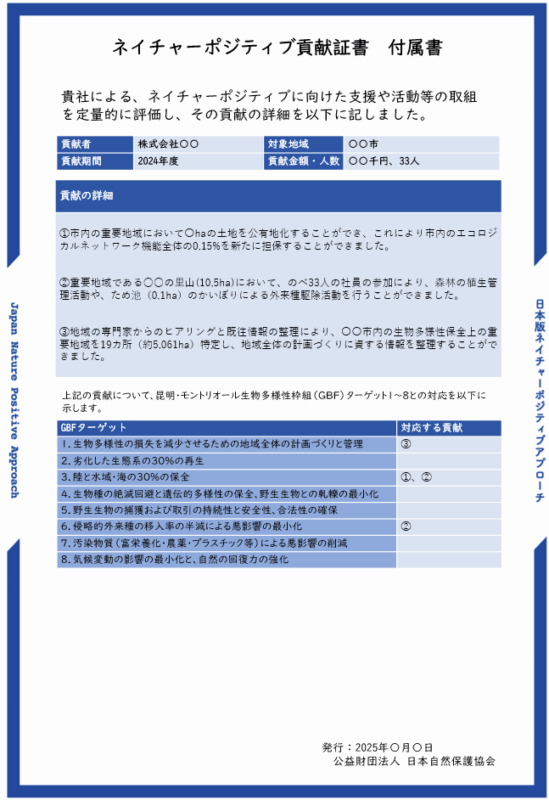
Image of annex to the Contribution Certificate
Details of the evaluation results are provided in the annex to the Contribution Certificate. Unlike the quantification of carbon dioxide reductions in climate change mitigation, assessing contributions to biodiversity conservation is widely recognized as highly challenging.
NACS-J conducts quantitative evaluations by incorporating the latest scientific knowledge with the cooperation of experts and research institutions across Japan. The methodology used for evaluation is aligned with “State of Nature Metrics,” which is discussed globally within frameworks such as TNFD. In addition, the assessment adopts perspectives that have been emphasized by the United Nations Environment Programme, such as Nature-based Solutions (NbS***), thereby ensuring a comprehensive evaluation approach.
Evaluation Methodology
Please refer to the following for details of the evaluation methodology (Japanese only) :
In municipalities that collaborate with NACS-J, Contribution Certificates are issued jointly in order to provide more official recognition of corporate contributions to regional Nature Positive efforts. On this occasion, certificates were jointly issued with four municipalities: Tokorozawa, Minakami, Koka, and Tadami.
Looking ahead, NACS-J plans to continue issuing Contribution Certificates annually to companies engaged in biodiversity conservation and restoration through the landscape approach. However, at present, companies are requested to meet the following requirements in order to be issued a Contribution Certificate.
Current Issuance Requirements
- The company has clearly documented through formal means its commitment to contributing to Nature Positive by engaging in biodiversity conservation or restoration through a landscape approach that considers the entire local (municipal) area.
- The company has established collaboration with the relevant municipality, or is actively working toward such collaboration.
- The company has no business activities or plans that would cause significant negative impacts on the natural environment of the relevant municipality.
- The company is making contributions to biodiversity conservation or restoration beyond its own sites within the municipality.
*Landscape Approach
A methodology that addresses diverse human activities and the natural environment in an integrated manner within a defined geographic area, based on land and spatial planning, in order to derive solutions to complex challenges.
**Taskforce on Nature-related Financial Disclosures (TNFD)
A framework for assessing the extent to which corporate activities depend on and impact nature, and for disclosing responses to nature-related risks and opportunities to shareholders, investors, and other stakeholders. The Taskforce on Nature-related Financial Disclosures published its international disclosure recommendations in 2023.
***Nature-based Solutions (NbS)
Initiatives that address societal challenges while delivering benefits for both people and nature through the conservation, restoration, and sustainable management of biodiversity. This approach has gained global attention as a pathway for solving social challenges, and its importance has been emphasized by the United Nations Environment Programme.
Latest List
2026.4.22
Unprecedented bird-strike risk: Opinion paper submitted on wind power project in Ishikari, Hokkaido
2025.12.19
Nature Positive initiative launched in Nose Town, Osaka
with support from Microsoft
In collaboration with the Foundation of Osaka Green Trust and local communities
2025.11.6